
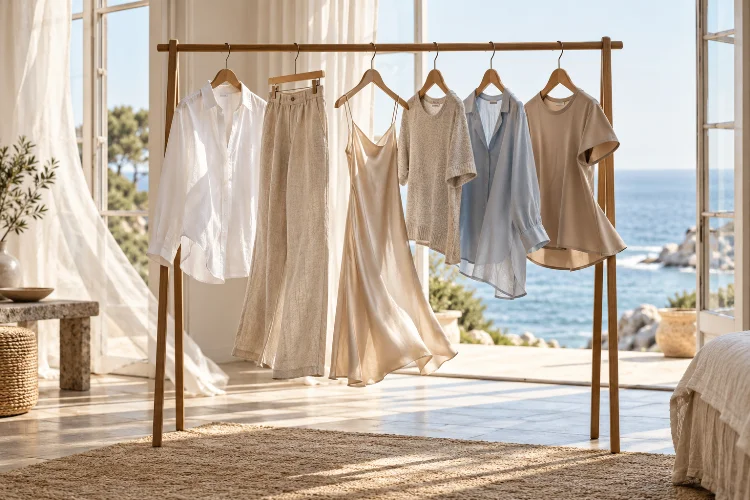
A fabric can look perfect for summer and still feel surprisingly uncomfortable after twenty minutes outside. That lightweight cotton shirt might become damp during a long walk, while the linen trousers that looked slightly heavier on the hanger could remain airy for hours.
The reason is that breathability is more complicated than simply choosing the thinnest fabric available.
Understanding how breathability changes across popular summer fashion fabrics requires looking at several characteristics at once. Fiber composition matters, but so do weave density, yarn size, porosity, moisture absorption, drying speed, and the amount of space between clothing and skin.
Even fabrics made from exactly the same fiber can perform differently when their construction changes. A recent study examining cotton textiles while keeping the fiber constant demonstrated how microscopic fabric geometry affects air permeability.
So instead of asking which summer fabric is universally “best,” it is more useful to understand how different materials behave – and match them to your climate, outfit, and activity level.
1. Linen: Excellent Airflow for Relaxed Summer Dressing
Linen has earned its reputation as a summer favorite largely because it is frequently made into relatively open, breathable fabrics.
According to REI’s guide to breathable materials, linen typically provides excellent breathability, partly because flax fibers are relatively large and linen clothing commonly uses more open weaves.
That makes it particularly effective in loose shirts, wide trousers, relaxed shorts, and dresses where air can move around the body.
However, linen is not automatically ideal for every hot-weather activity.
Like cotton, it absorbs moisture rather than functioning like a high-performance synthetic wicking fabric. During low-intensity activities such as lunch outdoors or sightseeing at an easy pace, this may not matter much.
During strenuous exercise, faster-drying alternatives can become more comfortable.
Fabric construction also changes the result. Research on hemp-linen textiles found meaningful differences in air permeability depending on weave and porosity.
So a loose linen shirt can be wonderfully breathable, while a dense linen jacket may feel considerably warmer.
2. Cotton: Breathable, Comfortable, but Moisture-Hungry
Cotton is probably the most familiar summer material, and for good reason.
It feels soft against the skin, can offer excellent airflow in lightweight constructions, and absorbs moisture readily. Cotton’s cellulose structure is hydrophilic, meaning the fibers naturally attract and absorb water.
That absorbency can feel comfortable during ordinary daily activities.
The drawback appears when perspiration becomes heavy.
Cotton does not generally wick moisture or dry as quickly as technical polyester or nylon. Once saturated, the fabric may stay wet against the body for longer.
This means cotton poplin, voile, seersucker, and lightweight gauze can be excellent for casual summer fashion, while a thick cotton jersey T-shirt may be less appealing for a long, humid hike.
Construction matters again. Higher-density cotton fabrics tend to offer less air permeability because their yarns leave fewer pathways for air.
Cotton can therefore range from extremely airy to unexpectedly warm.
3. Lyocell and Viscose: Fluid Fabrics With Moderate Breathability
Lyocell, viscose, and other rayon-family fibers are common in modern summer dresses, trousers, shirts, and skirts because they tend to feel smooth and drape beautifully.
REI characterizes rayon-family materials as moderately breathable and generally quick drying, although their exact properties vary significantly between fabrics and blends.
Lyocell deserves particular attention for moisture management.
Lenzing states that the structure of TENCEL Lyocell fibers enables moisture absorption and release, helping support a drier microclimate near the skin and improving thermal comfort.
That makes lyocell particularly useful when you want a more fluid appearance than linen provides.
Think wide-leg trousers that fall smoothly, a flowing midi dress, or a soft button-down shirt.
However, do not assume every garment labeled viscose or lyocell will feel equally breathablee. Density, blends, finishing treatments, and garment fit can dramatically alter performance.
4. Lightweight Merino: Surprisingly Capable in Warm Weather
Wool sounds like the last thing anyone should wear during summer.
Lightweight merino challenges that assumption.
Woolmark describes merino as a temperature-regulating fiber that can absorb moisture vapor and help manage the microclimate around the body. Its odor-management properties also make it useful for repeated wear during travel.
The critical word, however, is lightweight.
A thick wool knit remains inappropriate for most hot conditions. Fine merino T-shirts and lightweight base layers are a completely different category.
They can be useful for travel days, hiking, changing climates, or situations where you want to wear the same garment several times without it becoming unpleasant.
Compared with linen, merino tends to feel less obviously “summery,” but functionally it can be a strong warm-weather option.
This is a good example of why fabric assumptions are often less useful than actual performance.
5. Silk: Lightweight and Breathable, but Not Built for Heavy Sweat
Silk has several qualities that work beautifully in elegant summer fashion.
It is lightweight, soft, breathable, and naturally luxurious, making it attractive for evening shirts, dresses, skirts, and camisoles.
REI nevertheless points out an important limitation: silk is not particularly effective at moisture wicking and can retain odors. It is also more delicate than many everyday fabrics.
That means silk performs best in the right context.
For a shaded dinner terrace or an air-conditioned summer event, a silk blouse can be wonderfully comfortable. For a full afternoon of sightseeing under intense sun, it may not be the most practical choice.
Sweat can also become visible on certain colors and finishes.
Rather than treating silk as an all-purpose breathable fabric, think of it as an elegant low-to-moderate-activity option.
The distinction between comfort and performance matters.
6. Polyester and Nylon: Construction Determines Everything
Synthetic fabric has a complicated reputation during summer.
Cheap, dense polyester clothing can feel extremely hot. Yet polyester and nylon are also dominant materials in technical running shirts, hiking clothing, and performance apparel designed specifically for hot conditions.
The contradiction disappears once you look at construction.
REI notes that polyester and nylon typically wick moisture and dry quickly, while their actual breathability varies according to yarn size and whether the fabric is knitted or woven.
A dense polyester fashion blouse and an ultralight mesh running shirt may share the same basic fiber but behave almost nothing alike.
This is where synthetic fabrics can outperform natural alternatives.
During high-sweat activities, moving moisture outward and drying rapidly may matter more than absorbency. A well-engineered synthetic garment can therefore feel significantly more confortable than wet cotton.
The trade-off is that some synthetic materials retain odor more readily.
7. Fabric Construction Can Override the Fiber Label
One of the biggest mistakes in summer shopping is assuming that fiber composition predicts everything.
It does not.
A review of woven fabric research found that air permeability generally decreases as fabric structures become denser. Porosity, weave tightness, thickness, and fiber characteristics also influence moisture-vapor movement.
A separate study comparing summer fabrics reported air-permeability differences between cotton and several Tencel blends, illustrating how both material and construction affect the final result.
That means a loosely woven cotton shirt might breathe better than a densely constructed linen one.
Similarly, an open-knit polyester top may provide greater ventilation than a tightly woven viscose blouse.
Whenever possible, evaluate the actual fabric.
Hold it toward light. Notice how visible the spaces between yarns are. Feel whether the material is dense or airy.
The fiber label tells you what the garment contains; the construction tells you much more about how it may behave.
8. Breathability and Moisture Control Are Not the Same
Another useful distinction is the difference between letting air through and managing sweat.
Air permeability describes how readily air travels through the textile. Moisture management involves processes such as absorption, wicking, vapor transfer, and evaporation.
A fabric can perform well in one area without dominating the other.
Research into thermal wear comfort found that moisture-vapor behavior depends partly on fiber hygroscopicity and partly on fabric pore size and yarn construction.
This explains why linen can feel wonderfully airy during casual activities while technical polyester becomes more useful during intense exercise.
Neither fabric is universally superior.
They simply solve different comfort problems.
For sophisticated summer dressing, prioritize airflow and relaxed silhouettes. For highly active situations, quick drying and moisture movement deserve more attention.
That comparision is much more useful than simply dividing fabrics into “good” and “bad” categories.
9. Match the Fabric to What You Are Actually Doing
The best summer wardrobe usually contains several different fabric types.
For slow city days, linen trousers and an airy cotton shirt can provide plenty of comfort. A lyocell dress works beautifully when you want soft drape and a smoother silhouette.
For travel days or repeated wear, lightweight merino becomes interesting because of its moisture and odor characteristics.
For hiking, running, or long active excursions, technical polyester or nylon may make more sense because fast drying becomes a priority.
Silk can then occupy the elegant end of the wardrobe for dinners and occasions where activity levels are lower.
Instead of looking for one winning fabric, build a material strategy around how you spend your summer.
That approach creates better outfits and usually leads to fewer disappointing purchases.
Summer fabric breathability varies far more than simple labels suggest.
Linen often excels at airflow, cotton combines comfort with strong absorption, lyocell offers moisture control and fluid drape, lightweight merino handles moisture vapor well, and technical synthetics become valuable when rapid drying matters.
Silk brings lightweight elegance but works better for lower-intensity situations.
More importantly, weave, knit, density, yarn size, porosity, and garment fit can dramatically change the performnce of every one of these fibers.
The next time you shop for summer clothes, examine more than the composition tag. Feel the fabric, check its structure, consider your activity level, and choose the material that solves the specific heat and moisture challenges you actually face.