
When shopping for summer clothes, one piece of advice appears everywhere: choose lightweight fabrics. It sounds logical. Less material should mean less heat, right?
Not necessarily.
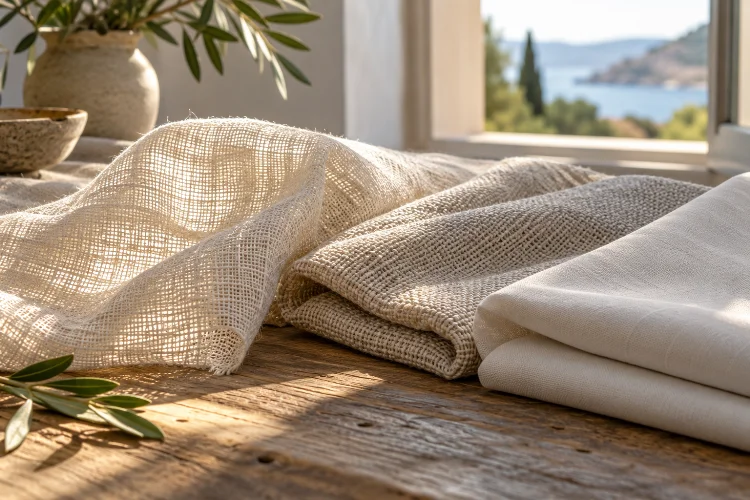
A lightweight fabric can still feel surprisingly hot when its yarns are packed tightly together. Meanwhile, a slightly heavier fabric with a more open structure may allow considerably more air to move through it.
That difference becomes especially noticeable during humid afternoons, long outdoor walks, and other situations where heat needs to escape from the body.
Understanding why fabric weave matters more than weight in summer clothing requires looking at fabric as a structure rather than simply measuring how heavy it feels. Yarn spacing, weave pattern, porosity, thickness, and density all affect how easily air and moisture can travel through a garment.
Research on woven textiles consistently shows that structural characteristics have a significant relationship with air permeability.
Once you understand those principles, choosing comfortable summer clothing becomes much more precise.
1. Fabric Weight Does Not Tell the Whole Story
Fabric weight is commonly expressed in grams per square meter, or GSM. A lower number generally means there is less material within a given area, which can certainly be useful in summer.
But weight alone cannot explain how that material is arranged.
Imagine two fabrics with relatively similar weights. One uses yarns packed closely together in a dense construction, while the other contains larger spaces between its yarns.
The first fabric may block more airflow despite feeling thin in your hand.
Textile research supports this distinction. Air permeability depends on a combination of thickness, porosity, yarn properties, warp and weft density, and overall fabric construction rather than mass alone.
So when evaluating summer clothes, asking “How light is it?” is useful.
Asking “How open is the structure?” is often even more useful.
2. Weave Density Controls How Easily Air Moves
Woven fabrics are created by interlacing warp and weft yarns.
How closely those yarns sit together has a major effect on breathabilty.
A dense construction leaves fewer or smaller pathways for air. A more open construction provides additional spaces through which air can travel between the outside environment and the microclimate around your skin.
A review of fabric weave research found that air permeability generally decreases as woven fabric structures become denser.
This explains why two cotton shirts can feel completely different in summer.
A tightly woven cotton piece may provide excellent structure and opacity but relatively limited ventilation. A loosely woven cotton shirt can feel noticeably airier despite containing exactly the same basic fiber.
Fiber matters, but architecture changes how that fiber behaves.
3. Porosity Is the Hidden Feature Behind Breathability
One of the most useful concepts when evaluating summer fabric is porosity.
In simple terms, porosity describes the empty spaces within a textile structure.
Those spaces can occur between fibers, between fibers inside yarns, and between individual yarns. For practical summer clothing, the spaces between yarns are particularly important because they can form pathways for airflow.
Research into woven textile permeability identifies pore size, shape, distribution, thickness, and yarn spacing as important variables affecting how air travels through fabric.
More recent research also describes effective porosity as a key factor in predicting airflow while keeping the underlying fiber material constant.
You do not need laboratory equipment to develop a rough impression of porosity.
Hold the garment toward a bright light. If you can detect small spaces between the yarns, its construction is relatively open. If almost no light passes through, the fabric is probably denser.
It is not a perfect scientific test, but it can reveal more than simply judging fabric weight with your hand.
4. Plain, Twill, and Satin Weaves Can Behave Differently
Not every weave arranges yarns in the same way.
Plain weave involves frequent intersections between warp and weft yarns. This often produces a stable, relatively firm construction.
Twill creates diagonal patterns by changing how yarns pass over and under one another. Satin uses longer floating sections with fewer intersections.
Those structural differences can influence air movement.
A study examining hemp-linen fabrics noted previous findings in which plain weaves showed lower air permeability than certain twill and satin structures. The same study found weave and picking sequence significantly affected airflow.
This does not mean satin is always cooler than plain weave. Fiber, density, yarn diameter, finishing, and garment construction still matter.
The practical lesson is broader: the weave pattern changes the internal geometry of fabric.
That structual difference can influence comfort even when two garments appear equally lightweight.
5. A Slightly Heavier Fabric Can Sometimes Feel Cooler
This sounds contradictory, but summer comfort is not simply a competition to find the lowest possible fabric weight.
Consider lightweight trousers that cling closely to your legs once you begin sweating. Although the material itself is thin, constant skin contact can quickly become uncomfortable.
Now imagine slightly heavier linen trousers with enough structure to hang away from the body.
The second pair may create a larger layer of air between your skin and the garment while also offering good permeability. In practice, that can feel more comfortable.
Research comparing hemp-linen woven fabrics confirms that fabric weight interacts with thickness, porosity, structure, and permeability rather than operating independently.
This is why judging summer fabric only by thickness can produce disappointing results.
Drape, looseness, and airflow need to be considered at the same time.
6. Weave Also Influences Moisture and Vapor Movement
Feeling cool is not only about fresh air entering clothing.
Perspiration also needs somewhere to go.
Your body continuously produces water vapor, and sweating increases dramatically as temperatures and activity levels rise. If moisture becomes trapped close to the skin, clothing starts to feel sticky even if the garment itself is lightweight.
Research on thermal wear comfort shows that moisture-vapor permeability is influenced by fiber characteristics as well as fabric pore size and yarn construction.
Another study found that changing weave structures affected both porosity and water-vapor permeability.
This is an important distinction.
A garment does not need to feel heavy to interfere with moisture movement. A thin but dense textile can still create resistance.
Good summer fabric therefore needs the right balance between coverage, airflow, and vapor transfer.
7. Open Weaves Come With Trade-Offs
If open structures increase airflow, why not make every summer garment extremely porous?
Because clothing needs to perform several jobs at once.
More openness can reduce opacity. It may also influence durability, stability, wind resistance, and how well the garment maintains its shape.
A semi-sheer linen shirt might be perfect over swimwear but inappropriate for an office. Very open crochet may provide excellent ventilation yet offer limited coverage.
Fabric design therefore involves compromise.
For summer trousers, you might want a denser material for opacity while using a relaxed silhouette to increase airflow around the body. For an overshirt, greater porosity may be more practical because another garment sits underneath.
Research into weave structure reinforces this trade-off: increasing density may reduce air permeability while improving properties such as abrasion resistance.
The best fabric is not simply the airiest one.
It is the one whose structure matches its purpose.
8. Yarn Size Can Change the Same Weave
Weave pattern alone is not the final variable.
The yarns forming that weave matter too.
Thicker yarns occupy more space. Finer yarns can be arranged differently, potentially changing pore dimensions, surface texture, thickness, and airflow.
Recent research into predicting textile air permeability identifies yarn diameter, yarn type, and warp and weft densities among the factors controlling fabric porosity.
That means two fabrics described as “plain weave cotton” can still behave very differently.
One may use fine yarns and an airy construction, while another uses thicker yarns packed tightly together.
This is another reason shopping by fabric names alone is unreliable.
Labels tell you what a garment contains. They rarely tell you how the textile was engineered.
9. Garment Fit Can Amplify a Good Weave
Even a highly breathable fabric cannot solve every summer comfort problem.
Fit determines how effectively the material interacts with the body.
Loose shirts, wide trousers, A-line skirts, and relaxed dresses allow air to circulate around more of the skin. Tight clothing creates greater surface contact, potentially limiting the practical benefit of an otherwise breathable textile.
For example, a loose poplin shirt can remain quite comforable because its shape keeps much of the fabric away from the torso.
Similarly, an airy linen weave becomes even more useful when cut into wide trousers instead of a skin-tight silhouette.
Advanced summer dressing therefore combines fabric engineering with garment architecture.
You are not simply choosing a breathable textile. You are creating a system where fabric, body, and surrounding air interact.
10. How to Evaluate Summer Fabric Before Buying
You do not need to become a textile engineer to shop more intelligently.
Start by touching the fabric. Notice whether it feels rigid, soft, dense, or airy.
Then hold it toward light and examine the spaces between yarns. Compare several garments made from the same fiber and you may be surprised by how different their structures appear.
Next, move the fabric around.
Does it collapse against the body, or does it maintain enough shape to create space? Does it stretch tightly when worn? Can you feel air passing through it?
Finally, consider the actual purpose.
A lightweight but dense shirt might be perfectly suitable inside an air-conditioned restaurant. For sightseeing in humid weather, greater air permeabilty may matter much more.
Instead of searching for the lightest possible garment, look for the most appropriate combination of weave, weight, structure, and fit.
Fabric weight matters in summer, but it is only one part of a much bigger comfort equation. Weave density, yarn spacing, porosity, thickness, and pore geometry determine how easily air and moisture can move through clothing.
That is why a very light fabric can still feel hot, while a slightly heavier but more open textile may remain surprisingly comfortable.
When shopping for warm-weather clothes, stop relying entirely on fiber labels and fabric weight. Examine the weave, hold the material toward light, consider how it drapes, and think about how much space the garment creates around your body.
Once you start seeing fabric as a structure rather than simply a material, choosing comfortable summer clothes becomes much easier.