
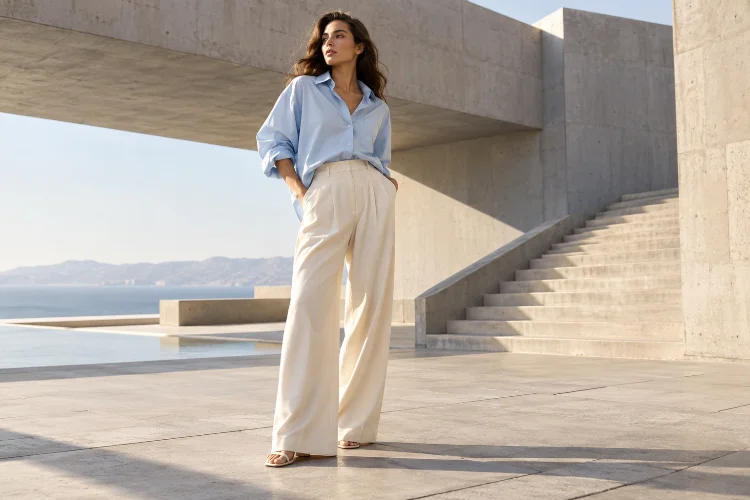
A summer outfit can contain beautiful individual pieces and still somehow look slightly off. The shirt may be perfect, the trousers may fit well, and the sandals may be stylish, yet the overall combination does not feel visually balanced.
The problem is often proportion.
Learning how to balance proportion in modern summer fashion outfits is less about following strict fashion rules and more about understanding how different shapes interact. An oversized shirt changes how wide trousers appear.
A high waist affects the visual length of your legs. Even the size of your shoes and handbag can influence the overall silhouette.
Summer makes these details especially noticeable because outfits typically contain fewer layers. With less fabric available to disguise awkward combinations, every hemline, volume, and shape becomes more important.
Fortunately, proportion does not have to be complicated. Once you understand several visual principles, you can make basic tanks, linen trousers, skirts, shorts, and dresses look considerably more intentional.
1. Understand Visual Weight Before Choosing Pieces
Proportion begins with visual weight.
Some garments naturally appear heavier than others. Wide-leg trousers, oversized shirts, full skirts, chunky shoes, and large bags occupy more visual space. Slim tanks, delicate sandals, narrow skirts, and small accessories create less volume.
A balanced outfit usually distributes that visual weight deliberately.
For example, wide-leg trousers paired with a streamlined tank create an easy contrast between volume on the bottom and simplicity on top. Vogue has similarly demonstrated oversized shirts with fitted tanks and wide-leg trousers, using the fitted layer to maintain definition within a relaxed silhouette.
However, this is not an absolute rule. Two oversized pieces can work together if there is enough structure, visible skin, or a defined focal point to stop the outfit from feeling shapeless.
The important question is not, “Is this piece oversized?” but, “Where is the visual weight concentrated?”
2. Create Contrast Between Fitted and Relaxed Shapes
One of the easiest ways to create balanced summer silhouettes is through contrast.
A fitted ribbed tank with flowing trousers works because each piece performs a different visual function. The top defines the torso while the trousers introduce movement and volume.
The opposite formula works too. Try an oversized cotton shirt with slim Bermuda shorts, a fitted skirt, or straight-leg trousers.
Current styling examples frequently use fitted tops, waistcoats, and simple tanks alongside wide-leg trousers because the difference in volume gives the outfit definition.
That does not mean you need to highlight every curve. The fitted element can simply be more controlled than the rest of the outfit.
Even partially tucking a loose shirt can create enough waist definition to change the silhoutte completely.
3. Use Waist Placement to Control Leg-to-Torso Balance
Where your waistband sits can dramatically change how an outfit looks.
High-waisted trousers and skirts visually raise the point where the legs begin, which can create the impression of longer legs. This becomes especially noticeable when paired with a tucked or cropped top.
Mid-rise styles create a more neutral balance between torso and legs, making them versatile for relaxed summer dressing.
Lower rises visually lengthen the torso instead. They can work beautifully with fitted tops, longer tanks, or cropped shirts when you want a more relaxed, elongated upper-body proportion.
There is no universally correct waist height.
The goal should be to create intentional relationships between the waistband and the top. A very long shirt worn over extremely high-rise trousers, for instance, may hide the waist entirely and make the outfit read differently from the same trousers worn with a fitted tank.
Modern fashion increasingly plays with these relationships rather than following a single proportion formula.
4. Pay Attention to Where Tops End
Hem placement matters more than many people realize.
A shirt ending at the widest part of the hip can visually create more width, while a slightly shorter or longer version may produce an entirely different effect.
Cropped tops naturally work well with high-rise trousers because the two hems meet close to the waistline. But longer tops are equally useful when styled intentionally.
Recent fashion styling has also embraced long-line tops over relaxed trousers, proving that balanced proportions do not always require emphasizing the waist. Longer tops can create a fluid, elongated line when both garments move softly rather than appearing bulky.
This is why experimenting in front of a mirror is useful.
Try the same oversized shirt completely untucked, half tucked, fully tucked, and open over a tank. The outfit may technically contain the exact same clothes, yet each version creates a different visual ratio.
Small adjustments can produce surprisingly dramaticc results.
5. Balance Wide-Leg Trousers Without Making Them Predictable
Wide-leg trousers have become a major foundation of contemporary warm-weather dressing because they combine airflow, movement, and sophistication.
But their volume needs consideration.
The easiest formula is a fitted tank or streamlined top. This gives the trousers space to remain the dominant silhouette. Fashion editors regularly recommend fitted or simple tops with wide trousers for precisely this reason.
However, oversized-on-oversized combinations can look more fashion-forward.
Try wide trousers with a loose button-down shirt, but roll the sleeves, leave several buttons open, or tuck one section into the waistband. These details reveal enough structure to prevent all that fabric from overwhelming the outfit.
Fabric also affects proportion.
Flowing linen trousers create softer volume than stiff denim, meaning they can tolerate a slightly looser top without becoming visually heavy.
6. Think About Shorts and Skirts as Vertical Proportions
Summer styling often focuses on whether shorts or skirts are “flattering,” but length is better understood as a proportion tool.
Very short shorts expose more leg and make the lower half of the outfit feel visually lighter. Longer Bermuda shorts create a stronger horizontal line around the thigh or knee and can support more structured styling.
Midi skirts create another relationship.
Because they cover much of the leg, they often work beautifully with fitted tanks, cropped shirts, or delicate footwear. Maxi skirts create even more vertical volume, so keeping some definition around the shoulders or waist can stop the look from becoming too heavy.
Instead of judging a hemline in isolation, look at the entire outfit.
A skirt that seems difficult with one top may suddenly feel balenced when the neckline, sleeve length, or shoe changes.
7. Use Exposed Skin as Negative Space
Not all proportion comes from fabric.
The areas where you are not wearing fabric also matter.
An open neckline between an oversized shirt and wide trousers creates visual breathing room. Sleeveless tops expose the shoulders, which can balance long trousers or maxi skirts. Cropped pants showing the ankle can visually separate the garment from heavier footwear.
Think of this exposed skin as negative space in graphic design.
When an outfit contains several oversized pieces, small areas of visible wrist, ankle, neck, or waist can prevent the silhouette from looking like one continuous block.
This strategy is especially helpful in summer because it provides both visual contrast and practical ventilation.
You do not need revealing clothing to use negative space effectively. Rolling shirt sleeves or choosing ankle-length trousers can create the same principle in a much subtler way.
8. Let Footwear Complete the Silhouette
Shoes are not simply an accessory added after the outfit is finished.
They affect proportion too.
Chunky sneakers add visual weight near the ground, which can work with oversized trousers or substantial shorts. Delicate sandals create less weight and can make long skirts or wide trousers appear lighter.
Sleek trainers are also frequently paired with wide tailoring because their casual shape reduces the formality of the trousers without competing heavily with their volume.
Hem length should interact with footwear.
Floor-grazing trousers create a long uninterrupted vertical line, while cropped trousers intentionally expose more of the shoe. Who What Wear has also highlighted high-rise, longer flared trousers as a way of visually extending the leg line.
Before changing an entire outfit, try changing the shoes.
Sometimes the proportion problem is happening at ground level.
9. Scale Accessories to the Outfit
Accessories have their own visual weight.
A tiny shoulder bag can create an interesting contrast with oversized clothing, while a large woven tote can reinforce the relaxed scale of a flowing summer outfit.
Neither approach is automatically better.
The same applies to sunglasses, jewelry, and belts. Oversized sunglasses can balance broad shoulders or voluminous clothing, while delicate jewelry allows dramatic silhouettes to remain the focus.
Belts are particularly useful because they can completely restructure an outfit.
A loose dress becomes two visually distinct sections once the waist is defined. An oversized blazer or shirt can also gain shape immediately from a belt.
Use accessories as proportion tools rather than simply decoration.
This makes styling feel more intentonal and usually reduces the temptation to add unnecessary pieces.
10. Break the Rules Once You Understand Them
Proportion rules are useful starting points, not permanent restrictions.
Traditional advice might tell you to pair wide trousers with something fitted. Modern fashion often does the opposite, combining oversized trousers with oversized shirts, long tops, or equally voluminous outer layers.
The difference between intentional volume and accidental shapelessness usually comes down to details.
Perhaps the shoulders remain structured. Maybe the sleeves expose the wrists. Perhaps the shirt and trousers are similar colors, creating one long vertical line.
Contemporary summer outfits often look interesting precisely because they bend conventional styling formulas.
Understanding proportion gives you the freedom to experiment without relying entirely on trends.
Learning how to balance proportion in modern summer fashion outfits is really about seeing clothing as a complete silhouette rather than a collection of individual pieces.
Consider where volume sits, where garments begin and end, how the waist is positioned, and how footwear completes the vertical line. Use fitted and relaxed shapes together when you want easy balance, but do not be afraid to experiment with oversized combinations once you understand their visual effect.
Most importantly, test your existing wardrobe before buying something new. Tuck a shirt differently, change the shoes, roll a sleeve, or adjust the hem.
Small proportion changes can completely transform an outfit – and mastering them makes summer dressing much easier.