
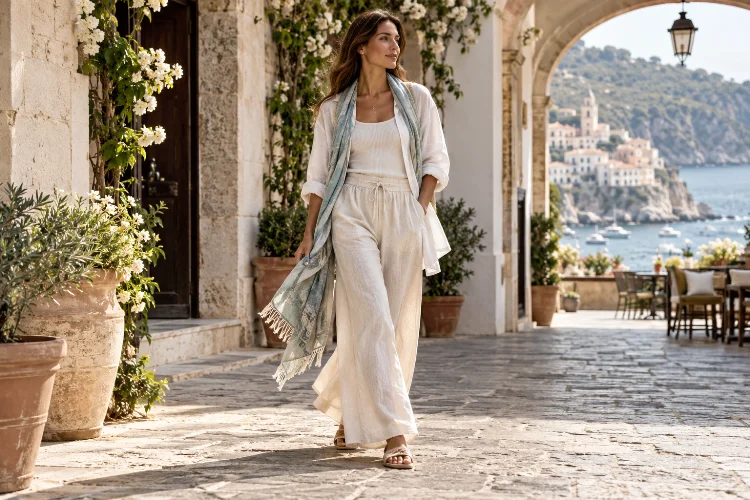
Resort dressing seems easy until one outfit needs to handle several environments. You might start with breakfast outdoors, spend the afternoon beside the pool, walk through town before sunset, and finish the day inside an aggressively air-conditioned restaurant.
That is exactly where lightweight layering becomes useful.
Learning how to create polished resort looks with lightweight layers allows you to adapt without carrying a complete change of clothes everywhere. The trick is choosing layers that add shape, texture, or coverage without introducing unnecessary heat and bulk.
Modern vacation wardrobes already lean toward packable pieces such as pareos, lightweight tees, tanks, swimwear, dresses, and breathable separates that can be combined repeatedly.
Vogue’s 2026 summer travel capsule guide, for example, emphasizes lightweight pieces that are easy to pack and remix throughout a trip.
Instead of thinking about layers as extra clothing, treat them as styling tools. The right shirt, scarf, or sheer piece can completely change a simple resort outfit.
1. Start With the Lightest Possible Base
Good summer layering begins underneath everything else.
Your base piece should be comfortable enough to wear alone because there will be moments when every outer layer comes off. Think fitted tanks, simple tees, sleeveless dresses, bodysuit-style swimsuits, or lightweight camisoles.
Keep the silhouette relatively clean.
A slim tank beneath an oversized linen shirt creates contrast between a defined base and a looser outer layer. The same principle works with wide-leg trousers, tailored shorts, or flowing skirts.
Vogue’s recent travel capsule recommendations include slim-fit tanks, lightweight tees, swimwear, and pareos precisely because compact basics can support multiple vacation combinations.
A strong base also prevents layering from feeling visually complicated.
If the first garment already contains dramatic sleeves, heavy texture, and a busy print, adding another piece becomes much harder.
2. Make a Linen Shirt Your Hardest-Working Layer
Few garments are as useful on a warm-weather trip as a relaxed linen shirt.
It can be worn buttoned as a regular top, left open over a tank, thrown over swimwear, tied loosely at the waist, or carried for cooler evenings.
Travel + Leisure’s 2026 summer packing coverage repeatedly includes linen shirts and pants among versatile warm-weather travel staples, while its tested layering guide focuses specifically on linen and cotton pieces for summer trips.
The key is choosing a shirt with enough room for airflow.
A slightly oversized fit usually works better for resort layering than something tightly tailored. Roll the sleeves when you want more shape, or leave the cuffs loose for a softer silhouette.
White, cream, pale blue, olive, or striped versions are especially easy to combine.
The result feels effortles without becoming sloppy.
3. Use Sheer Layers to Add Interest Without Weight
Not every layer needs to provide warmth.
Sheer shirts, lightweight crochet, mesh knits, and translucent dresses can create depth while allowing the base outfit to remain visible.
Imagine a simple black swimsuit with flowing trousers. It already works, but adding a sheer oversized shirt creates movement and texture without completely covering the look.
The same strategy can transform an uncomplicated slip dress.
A very light open-knit layer or transparent shirt introduces dimension while preserving the relaxed summer silhouette.
This technique is particularly useful when your resort wardrobe relies heavily on neutral colors. Instead of adding another shade, you can create visual variety through transparency and texture.
Just avoid stacking several statement textures simultaneously.
One interesting layer usually creates a more polished result than three competing ones.
4. Turn the Pareo Into a Real Styling Tool
A pareo should not spend the entire vacation folded beside a pool chair.
Because it is essentially a lightweight rectangle of fabric, it can perform several styling roles while taking up very little suitcase space. Vogue specifically includes gossamer pareos among practical summer travel capsule pieces.
Wear one traditionally over swimwear, but experiment beyond that.
A larger pareo can become a long skirt for lunch. Some can be tied over the shoulders as a relaxed cover-up, while smaller versions can introduce color at the waist.
You can also coordinate the print with otherwise simple clothing.
For example, an ivory swimsuit, loose white shirt, and printed pareo create enough personality without requiring additional statement accessories.
That is the value of lightweight resort layers: they should create more outfits without creating more luggage.
5. Control Proportion When Adding Oversized Pieces
Layering can quickly make summer outfits appear bulky if every piece has the same volume.
Proportion solves the problem.
If you wear a large linen shirt, consider pairing it with a fitted tank and tailored shorts. When wearing wide trousers, allow the inner layer to remain relatively streamlined before adding an open overshirt.
You can still combine oversized pieces, but create definition somewhere.
Roll the sleeves to expose the wrists. Leave the shirt open around the neckline. Show the waistband beneath the outer layer or use a partial tuck.
These small areas of negative space prevent fabric from merging into one large shape.
The outfit remains relaxed but feels more balenced.
6. Build Layers That Can Handle Temperature Changes
Warm-weather travel rarely means being warm every minute of the day.
Hotels, restaurants, airports, cars, and shopping centers may have strong air conditioning. Coastal destinations can also become noticeably cooler after sunset.
This makes one additional layer worth packing.
A lightweight cardigan, fine-knit sweater, cotton overshirt, or extremely soft wrap can provide enough warmth without occupying half your suitcase.
Travel + Leisure’s summer travel recommendations emphasize multipurpose basics precisely because pieces need to work across changing travel environments rather than just the hottest part of the afternoon.
Choose something that works with both dresses and separates.
A thin neutral cardigan, for example, can sit over a sleeveless dress at dinner and work with trousers during an early-morning transfer.
Functionality is part of polished dressing.
7. Use Layers to Move From Poolside to Lunch
Some of the best resort outfits do not require a complete change after leaving the pool.
Start with sophisticated swimwear.
A streamlined one-piece can work almost like a bodysuit beneath relaxed trousers or a skirt. Add an open linen shirt, structured sunglasses, and clean sandals, and the outfit feels appropriate for a casual lunch.
Vacation styling increasingly treats swimwear and cover-ups as part of a broader outfit rather than completely separate clothing categories. Vogue’s vacation-dressing guides similarly show resort pieces transitioning between poolside, brunch, shopping, and evening settings.
The outer layer is what makes the transition possible.
It introduces coverage and structure while allowing the underlying swimsuit to remain useful.
That is much smarter than carrying an entirely new outfit to the beach.
8. Layer Dresses Without Hiding Their Shape
Dresses already provide complete outfits, so layering them requires restraint.
The goal is usually to complement the silhouette rather than cover it completely.
A shirtdress can be worn open over a fitted base during the day and buttoned later. A simple sleeveless midi dress can take a lightweight cardigan after sunset.
An oversized shirt also works over more fitted dresses, especially when left open.
Vogue calls travel dresses among the most versatile pieces for summer vacations, highlighting their ability to work across different trip scenarios.
Pay attention to length.
If your dress is very flowing and your outer layer is equally long and voluminous, the proportions can become heavy. A shorter shirt or cropped knit may provide better contrast.
Let at least one layer preserve the body’s basic outline.
9. Keep the Color Palette Connected
Layering automatically introduces more visible elements, so color coordination becomes increasingly important.
You do not need to dress entirely in neutrals, but each layer should feel related to the next.
A cream tank, tan trousers, and white linen shirt create a soft tonal outfit. A black swimsuit under a striped blue shirt with white shorts creates stronger contrast while still maintaining a controlled palette.
Prints are easiest when surrounded by solid colors.
If your outer shirt has a bold tropical print, keep the base relatively simple. If your pareo provides the pattern, allow the swimsuit and shirt to become the visual background.
This prevents lightweight layering from becoming overcomplicatted.
Color should connect the pieces instead of making every garment compete for attention.
10. Finish Layers With Minimal Accessories
Layers already introduce visual depth, so you may need fewer accessories than usual.
A strong pair of sunglasses, simple earrings, clean sandals, and one useful bag can be enough.
Vacation outfits featured by Vogue frequently rely on carefully chosen accessories – raffia bags, sandals, necklaces, or hats – to establish resort character around relatively straightforward garments.
Consider texture rather than quantity.
A woven bag adds contrast to linen. Leather sandals give a sheer dress more structure. Metallic earrings can make a cotton shirt feel appropriate for evening.
Accessories should help clarify the outfit rather than add another layer of visual noise.
If you already have a tank, printed pareo, oversized shirt, statement bag, necklaces, earrings, hat, and bold sandals, removing something may actually make the look feel more expensive.
Editing is one of the simplest routes to a polsihed resort outfit.
Creating polished resort looks with lightweight layers is less about piling clothes together and more about making each layer useful.
Start with breathable base pieces, then rely on linen shirts, pareos, sheer fabrics, fine knits, and versatile dresses to add coverage, texture, and flexibility.
Pay attention to proportion and keep the color palette connected so additional garments never feel bulky or chaotic. Most importantly, choose layers that can move between different parts of the day – from the pool to lunch, sightseeing, and evening drinks.
Before your next trip, experiment with the clothes you already own. Try wearing each lightweight layer at least three different ways. If a piece can transform several outfits without adding unnecessary weight to your suitcase, it has earned its place.