
When summer temperatures rise, checking the fiber label is a good start – but it does not tell you the whole story.
Two shirts made from the same cotton can feel completely different on a humid afternoon. One feels light and airy, while the other seems to trap heat almost immediately.
The difference often comes down to fabric structure.
Understanding how fabric structure influences comfort in advanced summer style means looking beyond whether a garment is simply labeled cotton, linen, or synthetic.
Weave density, yarn thickness, fabric weight, porosity, drape, moisture movement, and even the space between clothing and skin all influence how comfortable an outfit feels.
Research into textile comfort consistently shows that air permeability and moisture transfer depend not only on fiber composition but also on how the material is constructed.
That knowledge becomes especially useful when building sophisticated summer outfits. You can choose clothing that looks structured and polished without accidentally sacrificing airflow and movement.
1. Fiber Content Is Only Half the Story
People often describe certain fibers as automatically “breathable,” but construction changes how those fibers perform.
Cotton, for example, is naturally associated with softness, absorbency, and breathability. CottonWorks identifies airflow, moisture handling, absorbency, and drying behavior among the important characteristics used when evaluating textile comfort.
But a tightly constructed cotton fabric can feel very different from an open, lightweight cotton weave.
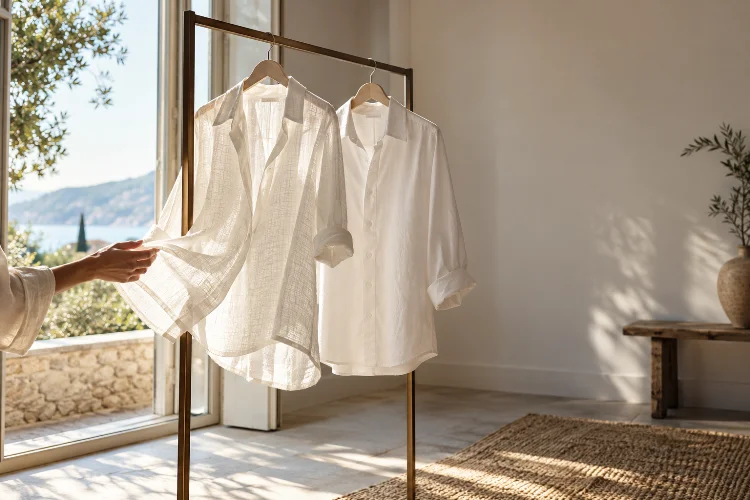
Imagine a dense cotton canvas shirt compared with a fine cotton voile shirt. Both may contain exactly the same fiber, yet the amount of air able to move through the material is dramatically different.
That is why advanced summer dressing should begin with the fabric itself rather than the composition label alone.
Touch it. Hold it up to light. Notice how dense it feels.
The stucture often tells you more about hot-weather performance than the fiber name printed on the tag.
2. Weave Density Directly Affects Airflow
One of the biggest factors in summer comfort is how tightly yarns are packed together.
Looser constructions generally create larger spaces through which air can move. Research reviewing woven textiles has found that air permeability tends to decrease as woven structures become denser.
REI offers a surprisingly practical test: hold fabric toward a light source. If more light passes through, the construction is generally more open and potentially more breathable, although other factors still matter.
This does not mean every summer outfit should be almost transparent.
A sophisticated linen trouser may need enough density to maintain shape and opacity. A resort shirt, however, can often use a more open structure because airflow matters more than stiffness.
The goal is matching construction to purpose.
Choose more open fabrics for relaxed shirts, cover-ups, and casual trousers, then use slightly denser materials where structure or coverage is important.
3. Fabric Weight Changes How Heat Feels
Weight and thickness also influence summer comfort.
A lightweight fabric usually places less material between the skin and surrounding air. That can make it easier for body heat to escape, particularly when the construction is also relatively open.
However, “lighter” does not automatically mean “better.”
Extremely thin fabric that clings tightly to sweaty skin can sometimes feel less comfortable than a slightly heavier material that hangs away from the body. Garment design and fabric behavior therefore need to be considered together.
REI’s guidance on breathable fabrics specifically identifies construction and weight as major factors affecting warm-weather performance. Tighter fabrics are generally less breathable, while thinner materials and finer yarns can help increase airflow.
For practical summer shopping, avoid judging fabric weight only with your hand.
Notice how the garment hangs when worn.
Sometimes a moderately lightweight wide-leg trouser feels more confortable than an ultrathin pair because its structure prevents constant contact with the legs.
4. Porosity Determines How Easily Air Can Travel
Porosity sounds technical, but the basic concept is straightforward: fabric contains tiny spaces between fibers and yarns.
Those spaces matter.
Research on woven textiles links fabric porosity closely with air permeability, while studies comparing hemp-linen constructions show that differences in weave and bulk density can meaningfully change airflow.
For summer styling, this helps explain why seemingly similar garments perform differently.
A dense plain weave may create a crisp, polished shirt, but an airier construction can feel cooler during long periods outside. Open crochet, lightweight gauze, and loose linen weaves increase visible porosity even further.
There is a trade-off, of course.
Highly porous fabrics may offer less opacity, reduced structure, or different sun protection compared with denser textiles.
That is where layering becomes useful. A lightweight open shirt over a minimal base can provide visual polish while preserving much of the airflow that makes the outer fabric comfortable.
5. Moisture Movement Matters as Much as Breathability
Summer discomfort does not come only from heat.
Moisture sitting against the skin creates that sticky feeling almost everyone associates with humid weather.
Textile comfort therefore depends on several processes: absorbing moisture, moving it through the material, allowing vapor to pass, and eventually helping it evaporate.
Research into woven performance fabrics shows that moisture vapor permeability can depend on both the hygroscopic characteristics of the fibers and the pore structure created by yarn construction.
Another study of woven fabrics found that wicking and evaporation are affected by fiber properties, fabric structure, and finishing treatments.
In everyday terms, there is no single “magic summer fabric.”
Cotton may absorb moisture comfortably, while engineered treatments or particular constructions can encourage moisture movement and faster drying.
CottonWorks, for example, describes moisture-management technologies designed specifically to modify how cotton handles perspiration.
Think about your activity level when choosing fabric.
A restaurant outfit has different moisture-management needs from something worn during hours of walking.
6. Drape Controls How Much Fabric Touches the Skin
Fabric structure also determines drape – how a garment falls and moves around the body.
This is crucial for elegant summer style.
A fluid material can create beautiful wide-leg trousers because gravity pulls the fabric downward instead of allowing it to stand rigidly around the body. A crisp poplin shirt, meanwhile, creates more space around the torso because the material naturally holds shape.
Both can be comfortable for different reasons.
The important thing is controlling skin contact.
Loose garments create small air spaces between fabric and body. Research into clothing insulation and airflow demonstrates that these air layers influence heat transfer, while garment fit and air permeability interact with movement and surrounding airflow.
This explains why a relaxed shirt can sometimes feel cooler than an extremely thin fitted top.
When developing an advanced summer wardrobe, think about drape and distance rather than thinness alone.
7. Structure Can Create Comfort Without Looking Casual
Breathable clothing does not need to look shapeless.
One of the most useful summer styling techniques is choosing fabrics that hold enough structure to create polish while remaining relatively light.
Cotton poplin is a good example. Its crisp finish can give an oversized shirt architectural shape, creating airflow around the torso while still looking refined.
Linen trousers achieve something similar in a different way. The material can provide visible texture and a defined silhouette without behaving like heavy traditional tailoring.
Even mechanical fabric construction can influence flexibility. CottonWorks notes that woven cotton can be engineered through construction to provide stretch and ease of movement without necessarily relying on synthetic stretch fibers.
This matters because physical comfort includes movement, not simply temperature.
A garment that restricts your shoulders, waist, or hips may feel uncomfortable even when the material itself is highly breathable.
Summer sophistication works best when structure and freedom are balenced.
8. Do Not Confuse Natural With Automatically Cooler
Natural fibers are extremely useful in warm weather, but treating all synthetic fabrics as hot – or all natural fabrics as cool – is too simplistic.
Construction can sometimes outweigh fiber category.
A tightly woven natural fabric may allow less airflow than a lightweight synthetic textile engineered with an open structure. Similarly, some performance fabrics are designed specifically to move moisture and dry quickly.
The opposite can also happen.
A synthetic fabric with poor air permeability and little moisture movement may feel uncomfortable very quickly in humid conditions.
Instead of shopping exclusively by material name, evaluate several variables together: construction, thickness, surface feel, stretch, drape, and garment fit.
This approach is more accurate and also gives you more styling options.
You can still prioritize linen or cotton if you prefer natural fibers, but you will make better choices by comparing individual fabrics rather than assuming every garment made from the same fiber will behave identically.
9. Use Fabric Structure to Build Better Summer Outfits
Once you understand fabric construction, getting dressed becomes surprisingly strategic.
A hot city day might call for loose trousers with good airflow, a lightweight tank, and a crisp open shirt. A humid resort evening could favor a fluid dress that sits away from the body rather than multiple fitted pieces.
You can also deliberately mix structures.
Combine a crisp poplin shirt with soft linen trousers. Pair a fine ribbed tank with a flowing skirt. Use an open-weave overshirt over a smoother base layer.
These contrasts create visual depth without adding heavy accessories or complicated layering.
Before buying summer clothing, spend a few seconds examining the textile itself.
Hold it toward the light. Compress it in your hand. See how quickly it returns to shape. Check whether it feels stiff, fluid, dense, or airy.
Those small observations can tell you a surprising amount about how the garment will behave when temperatures rise.
Fabric choice in summer is more sophisticated than simply deciding between cotton, linen, and synthetics. Weave density, porosity, weight, moisture transfer, flexibility, and drape all influence how clothing interacts with heat, movement, and perspiration.
Understanding those characteristics makes it easier to create outfits that look structured without feeling restrictive and lightweight without appearing overly casual.
The next time you shop for summer clothing, look beyond the fiber label. Examine the construction, test the airflow, notice the drape, and consider how much space the garment creates around your body.
Better summer style begins with understanding what fabric actually does – not simply what it is called.